Research paper demonstrates significant reduction in late stage lung cancer thanks to community based screening programme

An innovative cancer screening programme in Greater Manchester has led to a significant reduction in cases of late stage lung cancer according to findings published in the Journal of Thoracic Oncology.
The published findings demonstrate that despite only screening 2% of the population in part of Greater Manchester, the programme has identified 31% of all diagnosed cases of lung cancer in the area, and has led to a 22% reduction of late stage diagnosis.
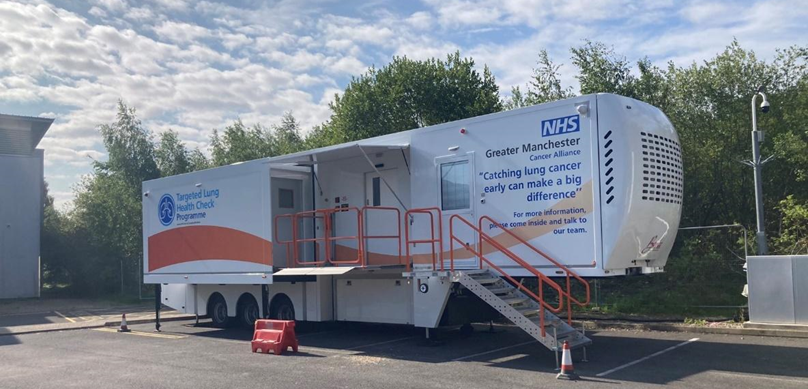
The screening programme is currently being rolled out to all residents who are current or former smokers and aged between 55 and 74, with eligible participants invited to attend a mobile NHS unit via a letter or text message. It is jointly organised by the Greater Manchester Cancer Alliance and Manchester University NHS Foundation Trust and supported by the Northern Care Alliance NHS Foundation Trust.
Former smoker Lesley Scott, 73 from Heyrod, was sent a letter inviting her to attend a screening at a mobile unit at a supermarket in Ashton-Under-Lyne.
Despite not feeling unwell or experiencing any symptoms, her scan came back positive for early stage lung cancer which was successfully treated with surgery. She said:
“That screening saved my life! I had no idea anything was wrong, but when I received a call a few days after my scan I thought ‘that doesn’t bode well’.
“I was really shocked when they told me there was a small nodule, but they referred me to Wythenshawe Hospital straight away, and I can’t fault the lung centre who were excellent with me.
“They told me it was lung cancer but very small and it had been caught early. I opted to have surgery, and touch wood things are fine.”
The findings come ahead of World Cancer Day which seeks to raise awareness of cancer and the importance of early diagnosis for conditions like lung cancer, which is the biggest cancer killer in the UK accounting for 35,000 deaths every year.
Survival rates for lung cancer decrease significantly the later the disease is detected, demonstrating the importance of screening programmes like this which aim to identify cases early.
Dr Patrick Goodley is a Consultant Respiratory Physician at Wythenshawe Hospital (part of Manchester University NHS Foundation Trust). He is part of the screening team and has been undertaking this work alongside researchers from organisations across Greater Manchester, including the University of Manchester. He said:
“The findings of our paper are extremely positive and demonstrate compelling evidence of the real benefit this screening programme has had in Greater Manchester.
“This sort of benefit has previously been shown in clinical trials, but this is the first time we’ve been able to show that a carefully managed public screening service can achieve similar impact.
“Targeted community-based lung cancer screening enables more people to be checked for the disease and is reducing the number of people diagnosed with late stage disease throughout our population. By catching it early, before it spreads, we have a much better chance of curing it.
“We are expanding the programme to cover all of Greater Manchester by the end of Spring 2026, and we’re delighted that this type of screening is now being rolled out across the country though the NHS Lung Cancer Screening Programme to help more and more people.”
Alison Jones, Director of Cancer Commissioning and Early Diagnosis at Greater Manchester Cancer Alliance, said: “NHS Lung Cancer Screening is playing a very important role in how we detect cases of lung cancer in Greater Manchester.
“Most importantly, more than 3 in 4 cancers have been found an early stage when lung cancer is potentially curable.
“By bringing the clinics directly into the community, we can screen those at most risk and intervene when the cancer is at its most treatable.”
Lesley encouraged anybody who is eligible to attend their appointment when they get their invite and get checked: “It’s really important that people read their letter and get checked, even if you don’t think anything is wrong as it may save your life!”.