Life-changing bond between hearing assistance dogs and humans to be boosted by relationship-based study
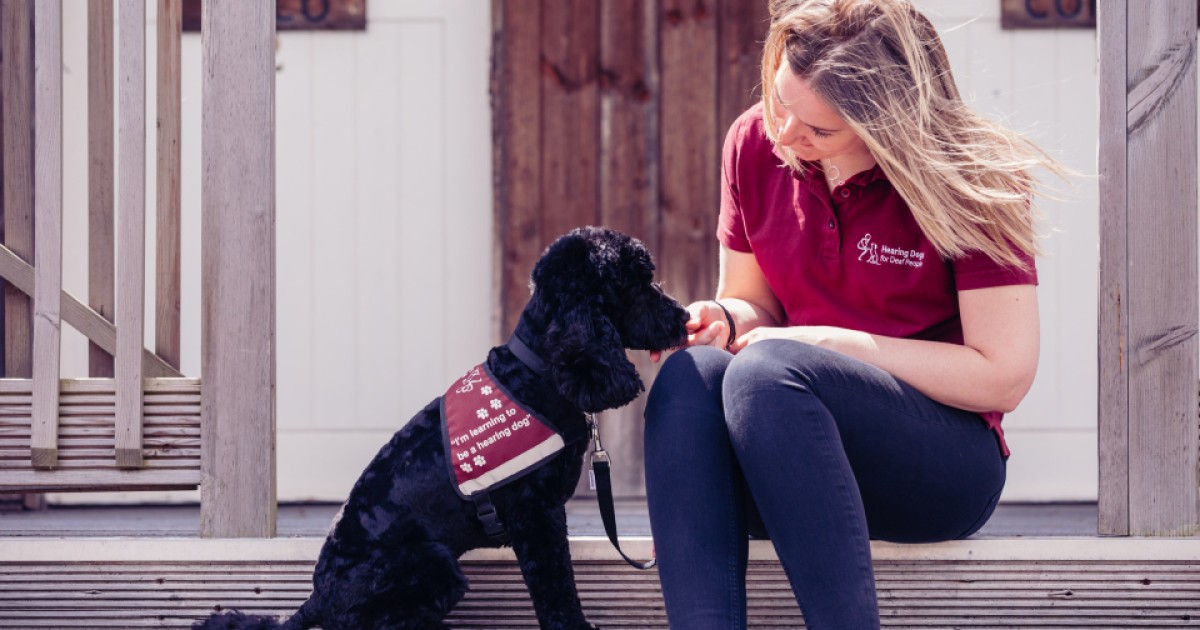
The bond between humans and canines is to be studied in a new partnership aiming to create more effective training that will forge positive feelings of connection and understanding between deaf people and their hearing dogs.
Manchester Met psychologists will partner with charity Hearing Dogs for Deaf People to develop a new approach that prioritises relationships, leading to stronger, healthier and longer-lasting bonds between hearing dogs and humans and, in turn, generates healthier and more productive partnerships.
Hearing Dogs for Deaf People trains specialist assistance dogs to alert their deaf partners to vital and life-saving sounds, as well as offer emotional support – particularly important when humans and dogs are in a working partnership.
The charity’s two-and-a-half-year partnership with Manchester Met will complement their existing hearing dog training by blending academic expertise, practical hands-on research, and AI emotion analysis software to develop new evidence for a relationship-based training approach.
The research team will capture and analyse video footage of human and hearing dog training sessions to identify ‘relational signatures’ – proximity, posture, interactions and reactions of dogs and trainers, like a human head tilt or a canine nose lick.
Understanding these subtle body language cues will help the team find moments of ‘attunement’ between the human and the dog, which can then be used to optimise the relational focus of the training for hearing dogs.
Strong bonds between volunteer hearing dog trainers and trainee hearing dogs are crucial to the success of the dogs’ subsequent working partnership with their deaf partners, ensuring a smooth transition and optimising long-term outcomes.
Professor Deborah James, Deputy Pro Vice Chancellor in Health and Social Care and Special Advisor for Health and Social Care to the Institute for Children’s Futures, said: “Our collaboration with Hearing Dogs for Deaf People will help to shift thinking beyond traditional reward-based dog training methods towards a greater understanding of the fundamental relationship at the heart of great human-dog partnerships – the source of wellbeing and happiness for millions of dog owners.
“By gaining a deeper understanding of body language signals and cues, we aim to create more effective training techniques that will benefit both the assistance dog community and, ultimately, other dog owners. The potential impact on animals’ and society’s health and wellbeing is exciting and far-reaching.”
Rebekah Barr, Associate Director of Service Design and Development at Hearing Dogs, said: “A hearing dog transforms the life of their deaf partner – rebuilding confidence, providing companionship, and helping them reconnect with the world around them. For those whose hearing loss causes isolation and limits their everyday activities, a hearing dog can be a real lifeline.
“Our partnership with the team at Manchester Met University on this study will enable us to develop an even deeper understanding of the dog-animal bond; how we connect with and understand each other, and how this can be applied to the training of these life-changing dogs to deepen their impact on the lives of people who are deaf or have hearing loss even further.”
This human-dog study follows other Manchester Met human-human research that has harnessed psychology expertise alongside technology to improve relationships, including a study of hidden and complex emotions in parents and the analysis of wearable headcam footage to decode parent and teenage interactions.
Manchester Met’s latest partnership with Hearing Dogs for Deaf People is what’s known as a Knowledge Transfer Partnership (KTP), one of several UK-wide programmes designed to foster innovation by linking organisations or businesses with academic institutions.