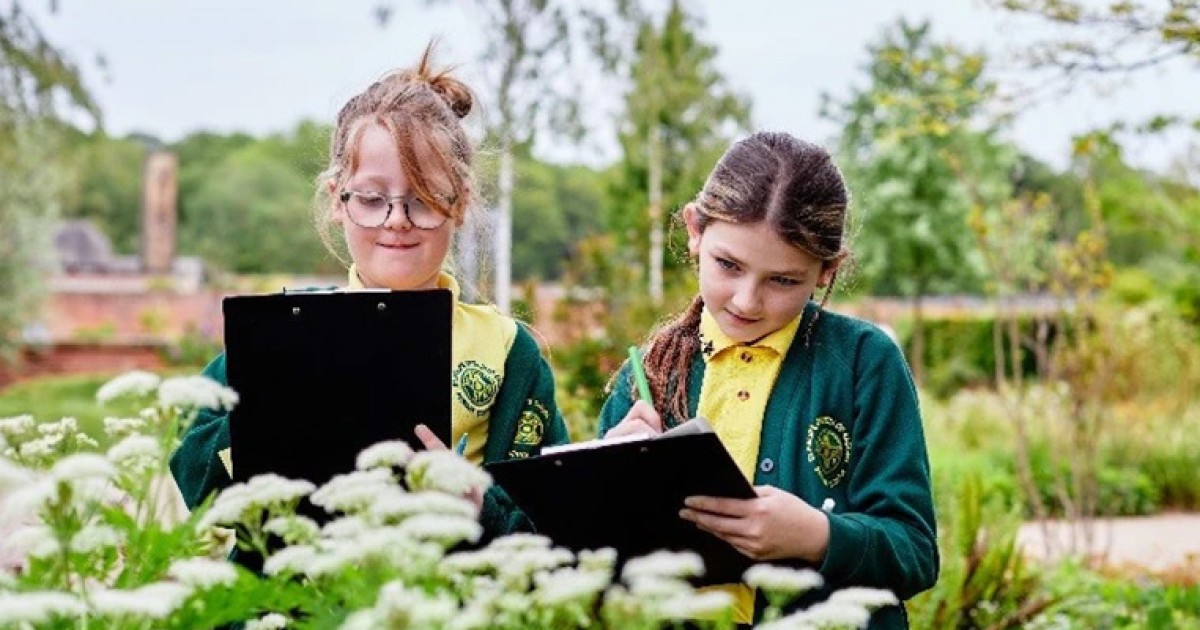
Over a quarter of all schools and colleges across England are coming together to create a network of green spaces to improve their outdoor site for thousands of young people, thanks to a trailblazing education programme.
The National Education Nature Park programme – commissioned by the Department for Education and run by a partnership including Manchester Metropolitan University and led by the Natural History Museum (NHM) with the Royal Horticultural Society (RHS) – has seen children across the country mapping, digging, planting, planning, learning and sharing.
These student-led improvements have boosted wellbeing, enriched outdoor learning, encouraged pupil responsibility and provided real-life context for curriculum subjects.
As the third academic year of the National Education Nature Park begins, the Natural History Museum has released some key highlights to demonstrate the success of the programme across settings in England:
- More than 1 in 4 primary and secondary schools registered
- 7,500 schools, nurseries and colleges registered
- More than 13 million square metres of habitat mapped across the education estate
- More than 1,100 schools, nurseries and colleges mapping their habitat
- Over £12 million in grants awarded to over 1,250 schools and nurseries
As the Higher Education partner in the National Education Nature Park programme, Manchester Met is working with the Department for Education (DfE), RHS and NHM to understand how further training and support for educators would enable deeper engagement with the programme.
Liz Price MBE, Professor of Environmental Education and Deputy Pro-Vice-Chancellor Sustainability at Manchester Met, said: “It is fantastic to see the impact that the Nature Park is already having on engaging young people in outdoor learning.
“As the university partner we are looking forward to continuing our work and research to ensure the activities and knowledge have a lasting impact on education settings and the environment.”
The overarching goal of the National Education Nature Park is to empower every child and young person in England, through their place of learning, to take action to make a positive difference to both their own and nature’s future by developing a connection to nature, understanding the threats facing it and feeling able to act for nature.
The project puts nature at the heart of the curriculum with resources across subject areas and key stages, with children taking part developing both green and digital skills.
Dr Jess Tipton, Head of the National Education Nature Park at the NHM said, “We’re incredibly proud of the young people and educators who have driven real change over the past two years. It’s inspiring to see over a quarter of schools nationwide now taking part, transforming their spaces however small and actively addressing biodiversity loss.
“This academic year, we’re aiming even higher, helping schools embed a culture where nature is at the heart of everyday learning. We’re also thrilled to be expanding the programme to include early years, with a specially adapted version that ensures the youngest learners can begin to make a positive difference to both their own and nature’s future from the very start.”
The programme is supported by grants from the DfE and administered by the RHS and regional teams working across all nine regions of England.
In its first two years, the programme awarded more than £12 million in DfE grant funding to over 1,250 schools, nurseries and colleges. A further £3 million has now been announced to support another 1,000 eligible education settings.
Funding can be used for gardening and fieldwork equipment, and for specialist support with installation and consultation. Those eligible for these grants have been selected by the DfE based on being in areas with higher levels of deprivation and lower access to green space.
Education Minister, Josh MacAlister, said: “From new ponds and green walls to diverse wildlife patches and water butts, thousands of children are now connecting with nature through our National Education Nature Park programme.
“This government is taking wide ranging action to break down barriers to opportunity – including by rebuilding 750 schools to be climate resilient, investing £100 million in sports facilities in schools and communities across the UK, and working to make sure that all children and young people have access to a variety of enriching experiences at school.”
The programme has recently reached the milestone of more than 1,100 schools creating a map of the habitats on their site, recording an area of over 13 million square metres, equating to around 10,400 Olympic-size swimming pools.
From recording trees and hedges, grassy areas, or even bare ground, mapping existing habitats is the exciting first step in young people understanding what their education site offers for nature, and choosing how to make meaningful improvements.
When a school, nursery or college takes part in the Nature Park, they’re joining a research team of thousands and contributing to trailblazing global biodiversity research. As well as being an education programme, the Nature Park is a major community science project investigating what’s living and growing on learning sites and how we can best improve them for nature.
Schools, nurseries and colleges in England can register for the Nature Park programme and begin their journey by heading to www.educationnaturepark.org.uk.