Manchester Met is celebrating the achievements of pioneering organisations across Greater Manchester, with a series of innovation awards recognising technological advancement.
The Innovate to Elevate awardsrecognise businesses that have participated in The Greater Manchester Innovation Accelerator pilot through either of the University’s Centre for Digital Innovation (CDI) or the Greater Manchester Electrochemical Hydrogen Cluster (GMEHC) programmes.
The CDI and the awards are led by the University’s Centre for Enterprisewhich supports companies that are pioneering new approaches in digital transformation and advanced innovation as well as supporting businesses developing innovation hydrogen technologies with the University’s Faculty of Science and Engineering.
Professor Jennie Shorley, Academic Director of the Centre for Enterprise, said: “These awards celebrate the progress, creativity and ambition demonstrated by organisations across our accelerator programmes, highlighting the transformative impact of Manchester Met’s innovation ecosystem on regional economic and technological advancement. This year’s nominees show how breakthrough ideas become real world solutions when government, academia and industry work together.”
The CDI’s new impact report highlights its successes: over three years it has engaged over 630 SMEs, supported the development of 82 new products and services, delivered digital skills uplift to more than 1,470 people, and leveraged over £6.38m in private-sector co-investment into the regional innovation ecosystem.
The GMEHC is dedicated to accelerating the development and widespread adoption of electrochemical hydrogen technologies. It supports Greater Manchester’s ambition to be net zero by 2038 and positions the region as a UK leader in hydrogen R&D.
Case Study
Liaura Ltd
Liaura, a double winner in the awards scheme, is developing a safe and age appropriate social and learning app for children, replacing addictive content and algorithm driven feeds with wholesome, educational activities as an alternative to adult oriented social media networks.
The company benefited from support through the CDI programme to create a prototype for testing in schools. As part of this support, Liaura was assigned a developer to carry out the coding, along with guidance on ethics and cybersecurity to inform research into how children can be kept safe on mobile devices.
Founder Hugo Shepherd said: “I’m absolutely delighted to win the secure the future and the technology for good award! I’m really excited to bring this innovation to families all over the country who are really worried about what their children are doing online and just give them that rosy feeling that their kids can learn digital skills and digital resilience without the downside.”
Award winners
The four award categories highlighted the breadth of innovation taking place across the region, The winners and highly commended entrants are listed below, see full details here.
Visionary Innovation Award – recognising businesses who have visionary ambition for new products, services and processes that are pushing the boundaries of possibility.
Winner: Dustid
Highly commended: Everlink.
Technology for Good Award – recognising leaders and businesses developing technology with a particular social, environmental, cultural and/or local goal.
Winner: Liaura Ltd
Highly commended: Pennine Consultancy
Greater Manchester Connected Innovators Award – celebrating businesses who are working across the vibrant Greater Manchester innovation ecosystem.
Winner: Luxfer Mel Technologies
Highly commended: INEOS.
Secure the Future Award – awarded to business leaders who are working to develop innovative products or services to develop a secure, innovative future.
Winner: Liaura Ltd
Highly commended: Melbec Microbiology Ltd
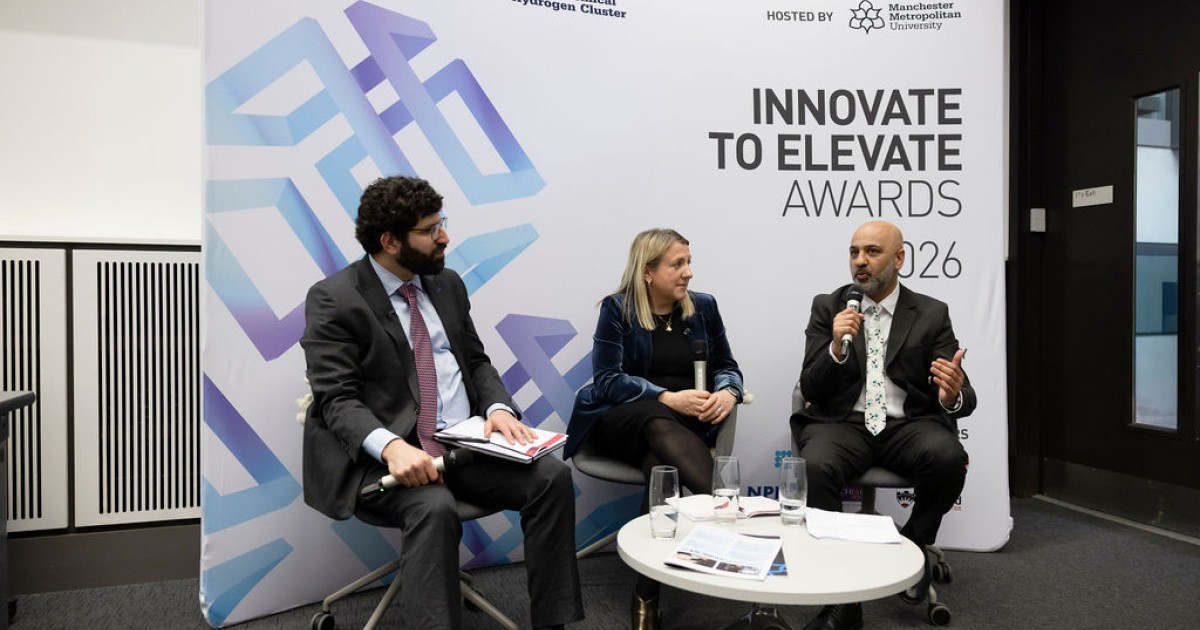
The awards event at the University’s Triple-Accredited Business School this week (4 March) welcomed keynote speaker Ben Fitzgerald, Chief Operating Officer, Aston Martin Performance Technologies who spoke about micro-innovation in action.
The CDI and GMEHC accelerator programmes are funded by Innovate UK and delivered through the Centre for Enterprise, in partnership with Greater Manchester Colleges, the Henry Royce Institute, Lancaster University, the National Physical Laboratory, the University of Manchester, and the University of Salford.
The new Centre for Enterprise report on AI adoption across Greater Manchester SMEs can be read here.