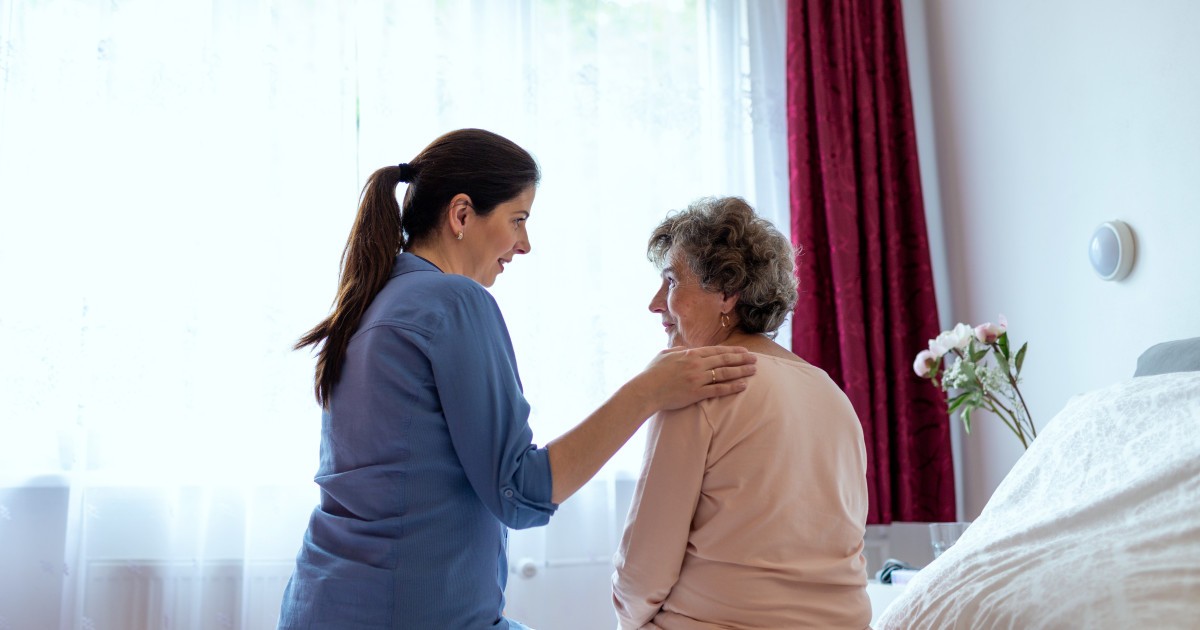
New dementia research reveals that while people with dementia may struggle to communicate, they still recognise when their questions are not properly answered, or care actions are not accounted for.
The findings could help family members and hospital staff ease distress and improve communication with loved ones or patients with dementia.
The research shows that even if patients with dementia don’t understand that they are in hospital or why, or even if their own speech is hard to make sense of, they still expect an appropriate response to their questions and expect to be given an account for healthcare staff’s actions or lack of actions in relation to their care.
The research used video-recorded hospital interactions to analyse communication between people living with dementia and healthcare professionals. The data was collected from four older persons’ wards in two acute NHS hospitals in the UK and involved 96 healthcare practitioners from a wide range of healthcare occupations including nurses, healthcare assistants, doctors and allied health professionals.
The research focused on acute general hospital wards, where people with dementia are admitted for medical reasons, such as falls or infections, and where staff typically have no specialist dementia training. With around a quarter of acute hospital beds in the UK now occupied by people with dementia, communicating effectively with this group of patients presents a growing challenge.
Professor Alison Pilnick, Professor of Language, Health and Society at Manchester Met, said: “We have shown for the first time in our research that even if people with dementia ask a question that is hard for staff to make sense of, they can recognise when they do not get an appropriate answer. Although many ordinary language competencies may be lost in more advanced dementia, this recognition of the fundamental structure of interaction can still be there.
“When questions go inadequately answered, or healthcare professionals don’t explain the reason for their actions, people with dementia can recognise this and call healthcare professionals to account for it.
“Being admitted to an acute hospital ward can be an incredibly difficult experience for someone with dementia, and our work has been focused on how staff can communicate better so that they avoid or manage distress.
“People with more advanced dementia might say things that can be hard to interpret, and they might not be oriented to the time and place of the hospital or the idea that they have any kind of medical condition that needs treatment. Because of this it can be easy for staff to assume that they lack other language competencies too, and that the ordinary norms of interaction don’t apply. Our research shows that making this assumption can provoke or increase distress”.
The study developed a communication training skills package that was piloted and evaluated over three different NHS trusts in London, Nottingham and Leeds. It has also been incorporated into an online training package that is available to all NHS staff.
Professor Alison Pilnick said: “An increasing number of the people healthcare staff will be caring for on acute hospital wards will have dementia. These staff will not usually have had any specialist training in dementia, leading to a situation that can be very stressful for both staff and patients.
“Our aim for this research was to develop easily accessible training to address this problem. While our research was hospital-based, our findings are applicable to anyone caring for someone with dementia in any context.”
Making sense of sense-making: The challenge of navigating interactional competence in dementia care is published in the Communication & Medicine journal.